
 Made to order
Vasoactive Intestinal Peptide
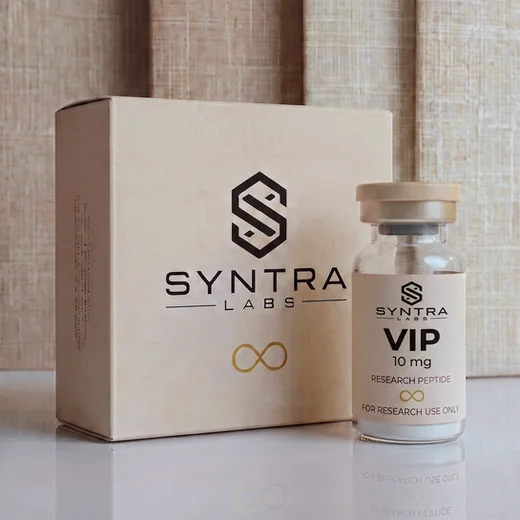
VIP 10 mg
A 28-amino-acid neuropeptide present in the central and enteric nervous systems. Its name comes from the first activity described for it — intestinal vasodilation — but later research focused on its immunomodulatory role and on the pulmonary epithelium. It is notably more labile than the rest of the catalogue: once reconstituted it loses activity in half the time.
- CAS
- 37221-79-7
- Formula
- C147H237N43O43S
- Molecular weight
- ≈ 3326,8 g/mol
- Sequence
- HSDAVFTDNYTRLRKQMAVKKYLNSILN-NH2
- Purity
- ≥ 98% verified by HPLC
- Presentation
- Amber glass vial with lyophilized powder, vacuum sealed.
- Includes 3 ml BAC waterIn the same box, at no cost.
How it works
- Agonism of the G protein-coupled receptors VPAC1 and VPAC2.
- Raises intracellular cyclic AMP.
- Activity described on type II alveolar cells and on surfactant production.
Qué dice la evidencia
- VPAC1/VPAC2 agonist with anti-inflammatory activity described on pulmonary epithelium.
- Intranasal administration protocols report microgram schedules split across several daily doses.
Route described in the studies
- Route
- Subcutaneous, the route the lyophilised vial supports. The published protocols mostly used the intranasal route.
- Preparation
- Reconstitute with BAC WATER without shaking. Protect from light.
- Application site
- Studies alternate the application site with each dose.
Documented effects
- Facial flushing from vasodilation
- Transient drop in blood pressure
- Nasal mucosa irritation in the intranasal studies
When it is not used
- Hypotension
- Pregnancy and breastfeeding
Storage
- Lyophilised
- 2 to 8 °C protected from light. Stable up to 24 months unopened.
- Reconstituted
- 2 to 8 °C, protected from light. Use within 14 days: it is more labile than the rest of the catalogue.
- Shipping
- Stable at ambient temperature in lyophilized form during shipping.
Preguntas frecuentes
Why only 14 days once reconstituted?
Because VIP degrades faster than the other peptides in the catalogue once in solution. The usual 30 days do not apply here: past that point the real concentration stops being the calculated one.
Is it injected or intranasal?
What is supplied is the lyophilised vial, reconstituted for the subcutaneous route. The published protocols we cite used intranasal formulations, a different presentation from the one shipped. The calculator splits the vial's content for the subcutaneous route.
Research use only
Este compuesto se vende únicamente para investigación de laboratorio y desarrollo analítico. No es un medicamento, no está aprobado por ninguna autoridad sanitaria, y no se vende para diagnosticar, tratar, curar ni prevenir ninguna enfermedad. No es apto para consumo humano ni animal.